Table of Contents
ToggleGetting an Overwatch tattoo is like wearing your gaming identity on your skin, a permanent tribute to characters, abilities, and moments that define your gaming journey. Whether you’re a hardcore esports fan who’s followed the competitive scene since the beginning or a casual player who just loves the character design, an Overwatch tattoo can be a meaningful way to show your passion for Blizzard’s team-based shooter. The challenge isn’t finding reasons to get inked: it’s deciding which design captures your attachment to the game. From iconic logos to beloved heroes like Tracer and Reinhardt, the Overwatch universe offers endless inspiration for tattoo artists and gamers alike. This guide walks you through the best character and logo designs, placement strategies, artist selection, and aftercare tips to help you commit to the perfect Overwatch tattoo.
Key Takeaways
- An Overwatch tattoo serves as a permanent tribute to your gaming identity, whether celebrating a favorite hero like Tracer or Reinhardt, a team allegiance, or a pivotal esports moment.
- Popular character designs include damage heroes like Genji and Widowmaker, support heroes like Mercy and Zenyatta, and tank heroes like Reinhardt, each offering distinct visual and personal meaning.
- The Overwatch logo and team emblems are instantly recognizable tattoo options that require minimal detail while providing maximum impact and community recognition.
- Placement strategy matters: visible areas like forearms and calves make a bold statement, while discrete placements on the chest or thigh offer flexibility for professional settings.
- Medium to large tattoo sizes (3–4 inches minimum) preserve design clarity and detail as your Overwatch ink ages, and selecting an artist with gaming-specific portfolio expertise ensures accurate proportions and aesthetics.
- Proper aftercare—including gentle cleaning, fragrance-free moisturizing, sun protection, and eventual touch-ups—preserves your tattoo’s vibrancy and ensures your gaming investment lasts for decades.
Why Overwatch Tattoos Resonate With Gamers and Esports Fans
Overwatch tattoos mean something different to everyone who gets them. For some, it’s about celebrating a hero that matches their playstyle, a Mercy main tattooing her character as a badge of honor, or a Widowmaker player immortalizing the perfect sniper headshot. For others, it’s about the community itself: the bond formed through ranked matches, team gameplay, and shared victories. The game launched in 2016 with a revolutionary approach to team shooters, emphasizing role-based teamwork over pure individual skill. That foundation created a fanbase that wasn’t just casual, it was invested, passionate, and eager to express that fandom.
Esports fans particularly gravitate toward Overwatch tattoos because the competitive scene tells stories worth remembering. Major tournament wins, iconic plays, and legendary team moments create emotional connections that go beyond typical gaming. A tattoo serves as a permanent reminder of those peak gaming moments, much like traditional sports fans tattoo their favorite teams or players. The game’s diverse hero roster also means there’s something for everyone: tank players, supports, DPS specialists, and flex players can all find a character that resonates with their identity. That inclusivity extends the appeal far beyond hardcore players, casual fans, artists, and even non-gamers appreciate the bold character designs and striking visuals that make Overwatch tattoos instantly recognizable.
Popular Overwatch Character Tattoo Designs
Tracer and Echo: Fast-Paced Favorites
Tracer is arguably the most iconic Overwatch hero, and her tattoo designs reflect that popularity. Her signature chronal accelerator backpack, mischievous grin, and British pilot aesthetic translate beautifully to ink. Most Tracer tattoos feature either her full character portrait or focus on her distinctive goggles and the glowing time-travel effect. The advantage of a Tracer tattoo is the recognizability, even non-gamers understand the futuristic aesthetic. Her sleek, aerodynamic design means the tattoo won’t feel cluttered or overly detailed, making it ideal for medium-sized pieces on the forearm, shoulder, or thigh.
Echo, the AI hero added in 2020, appeals to players who appreciate more abstract, tech-forward designs. Her geometric, angular appearance lends itself to cleaner linework and minimalist approaches. Echo tattoos often emphasize her distinctive face and the glowing blue accents that define her character model. Because Echo represents the evolution of Overwatch’s lore and gameplay, she attracts fans invested in the game’s narrative arc. Both heroes work well for players who main damage roles and want to showcase their fast-paced, carry-focused playstyle.
Tank Heroes: Reinhardt, D.Va, and Winston
Reinhardt is the game’s quintessential tank, and his hammer has become as iconic as his armor. Tattoo artists love Reinhardt designs because the gear-heavy aesthetic and imposing stature create natural focal points. His German knight aesthetic, complete with the Crusader armor and massive hammer, translates to bold, heavy-handed tattoos that demand space. Full-body Reinhardt pieces are rarer due to the detail required, but his hammer or shield logo makes for striking back or chest tattoos. Tank mains who pride themselves on leadership and game sense often choose Reinhardt as their tattoo subject.
D.Va offers a contrasting design, her mecha suit is sleeker and more futuristic than Reinhardt’s armor. Her sharp angles, neon accents, and Korean gaming culture influences create modern, eye-catching tattoos. Many D.Va fans opt for her bunny spray logo or the mecha’s head as a standalone piece, which works perfectly for ankle, wrist, or bicep placements. The pink and blue color gradients on her mecha suit also give talented artists room to experiment with color work.
Winston, the intelligent gorilla scientist, presents a unique challenge for tattoo design. His character is beloved, but realistic gorilla anatomy can be difficult to render in ink. Most successful Winston tattoos use stylized proportions, focus on his glasses and headpiece, or emphasize his tesla cannon. His character appeals to players who enjoy unconventional hero picks and appreciate Overwatch’s diverse roster.
Support Heroes: Mercy, Lúcio, and Zenyatta
Mercy is the second-most popular character choice for tattoos, rivaling Tracer in recognition. Her angelic design, flowing dress, and wings create natural, elegant tattoo compositions. Mercy players, especially those who’ve climbed ranks on pure support mastery, view her tattoo as validation of their role’s importance. Most Mercy tattoos feature her wings, staff, or full-body portrait. Because her design is inherently graceful, even complex pieces avoid the “busy” appearance that plagues some character tattoos. Back, shoulder, and thigh placements work best for showcasing her full design.
Lúcio appeals to support mains with a more playful, energetic vibe. His skateboard-riding, music-pumping aesthetic suits players who approach the game with humor and joy. Lúcio tattoos often highlight his sonic amplifier weapon or his dreadlocks and goggles. The character’s bright, vibrant color scheme translates well to color tattoos, especially if the artist incorporates the green healing and yellow speed amplification effects.
Zenyatta represents a more spiritual, philosophical take on support heroes. His monastic, omnic design carries philosophical weight that appeals to players who gaming as a meditative or mindful practice. Zenyatta tattoos typically feature his orbs, serene expression, or full robed figure. His symmetrical design and clean lines make him surprisingly practical for minimalist or geometric tattoo styles.
Damage Heroes: Widow, Genji, and Hanzo
Widowmaker commands attention in any tattoo design. Her lethal curves, tactical suit, and iconic sniper rifle create dramatic, striking pieces. For players who main Widow and pride themselves on headshot accuracy and positioning, a Widowmaker tattoo celebrates their mechanical skill and patience. Most Widow tattoos focus on her headshot pose or her distinctive face paint and yellow eyes. Her sleek silhouette works well for larger back or chest pieces, though arm tattoos can be equally impactful.
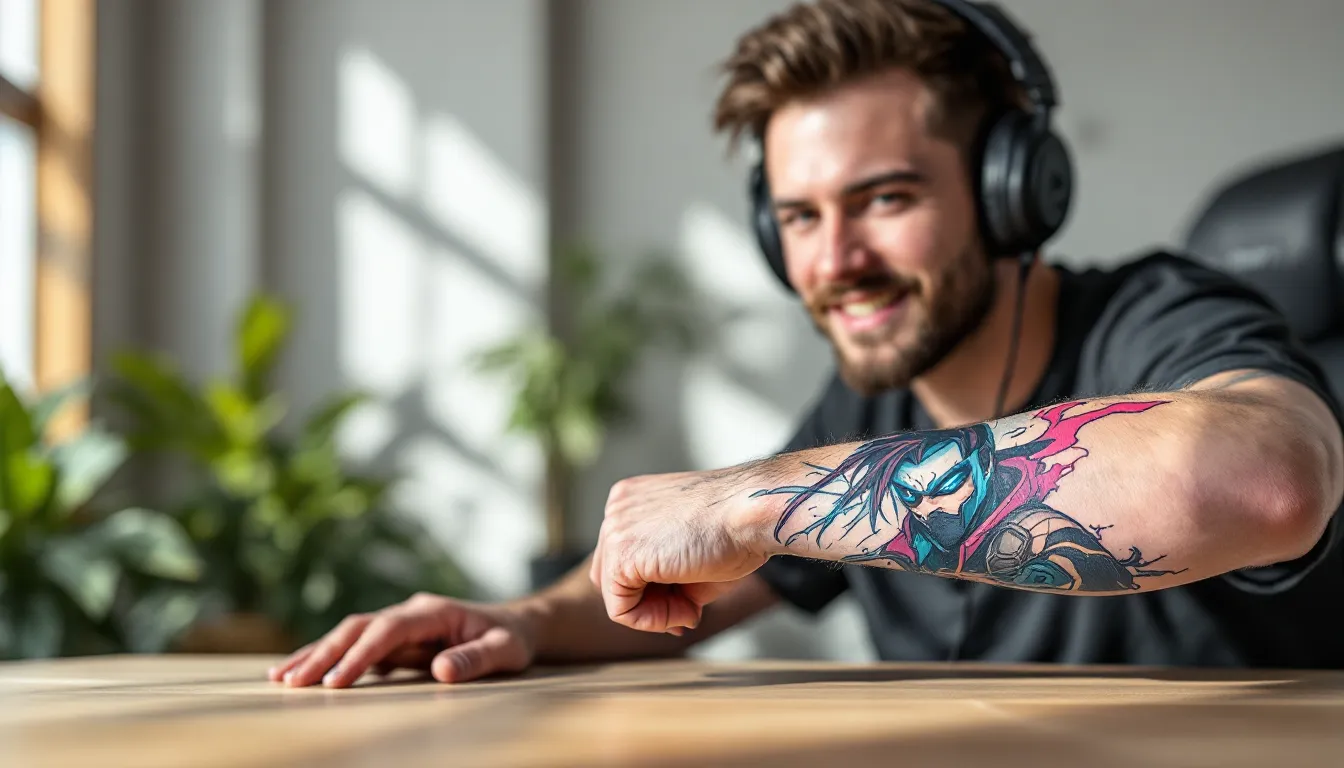
Genji’s cyborg ninja aesthetic has made him one of the most tattooed Overwatch heroes. His katana-wielding, wall-climbing playstyle appeals to players who enjoy mechanical complexity and high-skill-floor heroes. Genji tattoos range from his iconic “I need healing” expression to his shuriken swords and dragon form. The character’s Japanese influences and technical design elements attract tattoo enthusiasts who appreciate detailed, artistic linework. Arm and leg placements are ideal for Genji designs.
Hanzo, the archer and Genji’s brother, offers complementary design options. His bow, stoic expression, and dragon lore create compelling tattoo subjects. Players drawn to Hanzo often appreciate his positioning-based gameplay and the narrative weight of his character arc. His character design translates beautifully to color work, especially when incorporating dragon imagery and Japanese aesthetics. Hanzo tattoos often blur into broader gaming or anime-inspired designs, making them work well for players who want Overwatch representation that also fits their broader gaming interests.
For those wanting overwatch definition insights before committing to a character tattoo, understanding each hero’s role and playstyle in the game’s core mechanics can help ensure your choice reflects how you actually play.
Iconic Overwatch Logos and Symbols Worth Tattooing
The Overwatch Logo and Team Emblems
The Overwatch logo itself, a bold, geometric eye symbol, is instantly recognizable and translates beautifully to tattoo ink. The logo’s simplicity is its strength: clean lines, balanced proportions, and no wasted detail. This makes it perfect for first-time tattoo clients or anyone wanting subtle Overwatch representation. The logo works on any body part, from wrist to ankle, and looks equally sharp whether rendered in black ink or color.
Professional esports teams expanded the Overwatch logo universe significantly. Teams like Seoul Dynasty, San Francisco Shock, and London Spitfire developed distinctive emblems that fans now tattoo to show allegiance. Team logos offer a way to commemorate your favorite competitive squad or a pivotal moment in Overwatch esports. If you followed specific teams during the Overwatch League’s peak years (2018-2020 before the league’s restructuring), a team emblem carries nostalgic weight and community significance. These tattoos work particularly well for competitive fans who want representation without committing to a specific hero.
Ability Icons and Ultimate Symbols
Ultimate ability icons are underrated tattoo subjects that appeal to dedicated players. Each ultimate, from Tracer’s Pulse Bomb to Zenyatta’s Transcendence, has distinctive visual language. A Pulse Bomb icon tattoo is compact, recognizable, and instantly connects with the Overwatch community. These ability icons are also useful for players whose favorite hero has changed or evolved: the icon serves as general Overwatch representation rather than character-specific fandom.
The ultimate charge sound effect (that iconic “ding”) has become cultural shorthand for Overwatch, and some players tattoo the visual representation of that charge meter. These abstract designs appeal to players with minimalist taste or those who want subtle Overwatch references. Ability icons also work well as accent pieces or sleeve filler, especially when combined with character designs or logos for a more comprehensive Overwatch composition.
According to coverage from esports and competitive gaming insights, professional players often develop deep connections to specific abilities and playstyles, making ability-focused tattoos increasingly popular among the esports community. The symbolism extends beyond aesthetics, it represents mechanical understanding and game sense.
Placement Considerations for Gaming-Themed Tattoos
Visible vs. Discrete Placements
Placement choice shapes how your Overwatch tattoo interacts with the rest of your life. Visible placements, forearm, neck, hand, calf, make a statement. They announce your gaming identity to everyone you meet and create immediate connection points with other Overwatch fans. If you’re proud of your gameplay, love discussing the game, or work in a gaming-adjacent field, visible placement makes sense. Many professional esports players, streamers, and gaming content creators wear their Overwatch tattoos proudly on arms or legs because it’s part of their personal brand.
Discrete placements, upper arm, thigh, chest, back, offer flexibility. These areas stay hidden during most professional or formal situations while remaining easily visible in casual settings. Many players choose discrete placement if they want the personal meaning of the tattoo without constant public declaration. A chest or upper back placement is particularly popular because it allows for larger, more detailed designs while remaining hidden under standard workplace clothing. This balance appeals to players who love Overwatch but also work in conservative industries.
Size and Detail: Making Your Design Stand Out
Tattoo size directly impacts design complexity and longevity. A small character portrait (postage stamp-sized) loses detail as it ages, whereas a medium to large piece (palm-sized to larger) maintains clarity for decades. Overwatch character designs are visually dense, they’re meant to stand out on a video game screen. Translating that into tattoo work requires proportional sizing. A Reinhardt hammer works fine as a 2-inch tattoo, but a full-body Reinhardt portrait needs significant space to avoid muddiness.
Most artists recommend at least 3-4 inches for character portraits and ability icons. This size allows for proper line definition, accurate proportions, and color saturation (if you choose color work). Larger pieces, 6 inches and up, showcase the intricacy of designs like Genji’s armor or D.Va’s mecha suit. Sleeve tattoos, back pieces, and chest pieces offer enough canvas to include multiple heroes or layered design elements, creating a comprehensive Overwatch sleeve or full back piece.
The trade-off is time and cost. Larger pieces require multiple sessions, ranging from 2-6+ hours depending on complexity and color. Budget accordingly and discuss session length with your artist during consultation. For those interested in broader gaming tattoo strategies, exploring collaborative game crossovers and exciting designs can help you plan multi-hero or fusion pieces that maximize your canvas.
Finding the Right Tattoo Artist for Your Overwatch Design
Portfolio Review and Gaming-Specific Expertise
Not all talented tattoo artists excel at character work or gaming-specific designs. The style you choose, realistic, semi-realistic, stylized, minimalist, should align with your artist’s proven strengths. Review portfolios on Instagram, TikTok, or the artist’s website specifically for character work, animation-style pieces, or video game tattoos. If an artist has previous Overwatch or gaming tattoos in their portfolio, that’s valuable proof they understand the characters, proportions, and visual language.
Asking direct questions matters: Have they tattooed Overwatch before? Are they familiar with the character designs? Can they handle the specific color palette or style you want? A skilled artist new to Overwatch can absolutely deliver, but one who’s familiar with the game’s aesthetic will require fewer reference corrections and produce more accurate designs. Check reviews from other gaming clients specifically. Gamers tend to be detail-oriented and will mention if an artist missed crucial elements or proportions.
Location hunting also impacts results. Tattoo shops in major cities with strong gaming communities often employ artists with gaming expertise. Shops near esports venues or in areas with high gamer populations typically have portfolios tailored to this clientele. But, don’t dismiss local artists, some of the best character work happens in smaller towns by artists who’ve developed expertise through dedicated study and practice.
Collaboration and Custom Design Tips
Your tattoo artist should treat your consultation like a collaborative design session, not a rubber-stamp operation. Bring references, screenshots, official artwork, fan art, showing exactly what appeals to you. Do you want a specific pose? A particular color scheme? Should the design be photo-realistic or stylized? The more detail you provide, the closer the final design matches your vision.
Good artists will provide digital mockups (called “stencils” or “drafts”) before beginning the actual tattoo. This lets you see proportions, placement, and detail at full scale. Request modifications if something feels off. Perhaps the Tracer portrait needs her goggles larger, or the Reinhardt hammer should angle differently. Artists worth their salt expect revision requests and build them into the consultation process.
Custom elements elevate your tattoo from generic to deeply personal. Maybe you want your in-game username incorporated with your hero, or you want multiple characters arranged in a meaningful composition. Perhaps you’re combining your main character with your partner’s character in an artistic way. These custom touches require more time during design but create truly unique pieces that reflect your individual gaming identity. For inspiration on how gaming collaborations and creative combinations work, exploring playful gaming adventures and creative ideas can spark design concepts you hadn’t considered.
Discuss cost and payment before starting. Complex custom work costs more than standard designs, and larger pieces cost proportionally more than small ones. Most reputable artists require a deposit to secure a booking, with the balance due before or after the appointment depending on shop policy.
Tattoo Care and Preserving Your Overwatch Ink
Aftercare makes the difference between a vibrant tattoo that lasts decades and one that fades or distorts. Your artist will provide specific instructions, but the basics apply to all Overwatch tattoos: keep it clean, moisturized, and protected from sunlight during healing. Fresh tattoos are open wounds, and proper care prevents infection and ensures colors set correctly.
For the first 2 weeks, wash the tattoo gently with unscented soap 2-3 times daily. Pat dry (don’t rub) and apply a fragrance-free moisturizer or specialized tattoo aftercare product. Avoid submerging the tattoo in water, no swimming, hot tubs, or soaking baths, for at least 2 weeks. Wear loose, breathable clothing over the tattoo to prevent friction and sweat buildup. Many artists recommend avoiding exercise or heavy sweating during initial healing.
Sun exposure fades tattoo ink faster than almost any other factor. Once healed (typically 2-3 weeks), apply SPF 30+ sunscreen to your Overwatch tattoo whenever exposed to sunlight. This simple habit extends your tattoo’s vibrancy for years. If you’ve chosen a visible arm or leg placement, make sunscreen part of your regular routine.
Touching up tattoos after a few years is normal, especially for color work. Outline stays sharp longer than colors, so character portrait tattoos might need a color refresh every 5-10 years depending on sun exposure and skin type. Discuss touch-up policies with your artist during your initial consultation. Most reputable artists offer discounted touch-ups years after the original work, viewing it as ongoing relationship rather than a separate transaction.
Avoid amateur suggestions about lemon juice, hydrogen peroxide, or other “home remedies.” These damage ink and skin. Trust the process your artist outlines and follow it consistently. Your fresh Overwatch tattoo is an investment in your gaming identity, aftercare is the insurance policy that protects that investment.
Creative Fusion Designs: Blending Overwatch With Other Gaming Franchises
Some players want Overwatch representation that also honors other gaming loves. Fusion tattoos creatively blend Overwatch characters or logos with other franchises, creating unique pieces that tell a richer gaming story. A Genji character wearing armor inspired by Valorant’s design aesthetic, or Tracer merged with Halo’s sci-fi aesthetic, creates visually compelling hybrid designs.
Common fusion approaches include character crossovers (reimagining Overwatch heroes in different game styles), logo mashups (combining Overwatch’s eye with another game’s emblems), and thematic combinations (characters arranged thematically rather than realistically). The key is ensuring both franchises are represented meaningfully rather than creating confusing mashups that serve neither game.
These designs appeal particularly to players who stream multiple games, compete across different titles, or view gaming as a broader lifestyle rather than attachment to a single title. According to coverage from gaming news and comprehensive guides, many esports professionals compete in multiple games across their careers, making fusion tattoos a natural expression of their diverse competitive identity.
Discuss fusion concepts thoroughly with your artist. Poorly executed crossovers feel chaotic rather than clever. A skilled artist can incorporate visual language from multiple games cohesively, creating pieces that appeal to fans of both franchises. Start with black-and-white line work for complex fusions, adding color to an already complex design increases the risk of visual confusion.
Conclusion
Your Overwatch tattoo is a permanent declaration of what the game means to you. Whether you’re drawn to iconic characters like Tracer and Reinhardt, the bold simplicity of the Overwatch logo, or custom fusion designs that blend multiple gaming worlds, the key is choosing something that resonates deeply. The decisions matter: selecting the right character or symbol, finding an artist who understands gaming aesthetics, choosing placement that fits your lifestyle, and committing to proper aftercare.
Start your journey with clarity about why this tattoo matters. Is it about a hero who defines your playstyle? A team you followed through competitive seasons? A moment in Overwatch that changed how you saw gaming? That foundation ensures your choice feels authentic rather than impulsive. Take time reviewing artist portfolios, gathering references, and planning your design through thorough consultations.
Remember that game metas shift, favorite heroes evolve, and gaming interests change, and that’s fine. A well-executed Overwatch tattoo transcends the specific patch or season. It captures a moment in your gaming history and immortalizes the passion that drove you to get inked. That’s worth doing right. Invest in quality artist work, follow aftercare instructions meticulously, and wear your Overwatch ink with confidence. Your gaming identity is worth the permanent space on your skin.